Mold production is a critical process that directly affects product quality and production efficiency in the electrical materials industry. A correctly designed and manufactured mold ensures that millions of parts are produced at the same quality.
Mold Types
The main mold types used in electrical materials production:
- Injection Molds: Used for plastic plug, socket, switch and box bodies. Can work with hot runner or cold runner systems.
- Compression Molds: Used for thermoset materials. Especially preferred for high temperature resistant electrical components.
- Metal Molds: Used for press forming of brass pins, contacts and metal accessories.
- Progressive Dies: Used for multi-operation part production from metal sheets. Common in terminals and connectors.
Mold Design Process
Modern mold design requires advanced technology software and engineering knowledge:
- Product Analysis: Technical drawings and functional requirements of the part to be produced are examined.
- 3D Modeling: Mold design is done with CAD software such as SolidWorks, CATIA or NX.
- Flow Analysis: Plastic flow analysis is performed with simulation software like Moldflow.
- Cooling Design: Optimum cooling channels are designed to minimize cycle time.
- Tolerance Calculations: Shrinkage allowances and thermal expansion calculations are made.
Mold Manufacturing with CNC
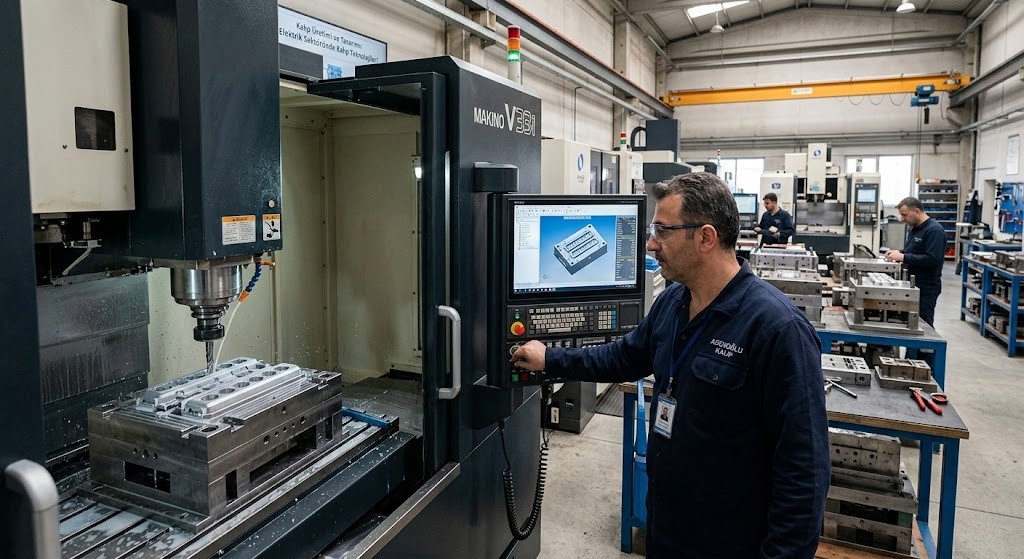
CNC (Computer Numerical Control) machines are indispensable in mold manufacturing:
- CNC Milling: Precision machining of mold cavity and core. 3-axis, 4-axis and 5-axis machines are used.
- CNC Wire EDM: Precision cutting in hard steel molds. Works with micron-level tolerances.
- CNC Sinker EDM: Creating complex cavities. Copper or graphite electrodes are used.
- Grinding: Improving surface quality and obtaining final dimensions.
Mold Materials
Steel types used in mold manufacturing determine the mold life and production quality:
- P20 Steel: For medium volume production. Offers good machinability and adequate hardness.
- H13 Steel: For applications requiring high temperature resistance. Preferred in aluminum injection.
- S136 (AISI 420): Corrosion resistant stainless mold steel. Used in optical parts and medical applications.
- 2738 Steel: Pre-hardened steel optimized for large molds.
Mold Maintenance and Lifespan
Regular maintenance extends mold life and maintains production quality:
- Cleaning and lubrication after each production session
- Periodic wear inspection and measurement
- Cleaning of cooling channels
- Renewal of surface coatings (chrome, nitriding)
A well-maintained injection mold can perform between 500,000 and 1,000,000 cycles. At Azenoğlu Electric, we apply the highest standards in mold production and maintenance, offering our customers long-lasting and efficient mold solutions.